

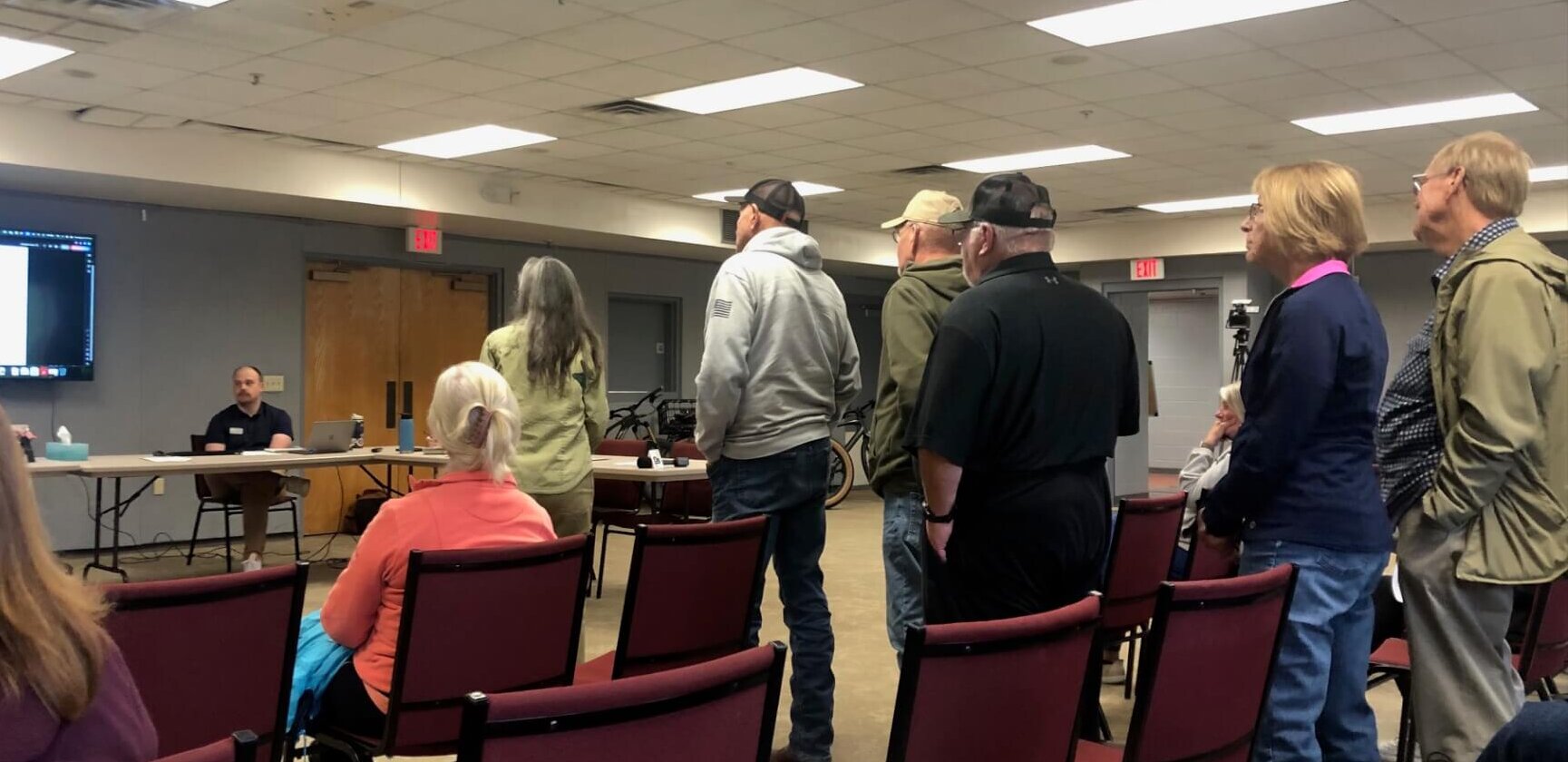
E-bike Task Force
A full house showed up for the E-bike and Multi-use Task Force Meeting last night at Lakeview Arena. At least two dozen citizens, seen above, voiced their concerns and shared their ideas about our bike paths, and how we use them. Before the ad hoc committee goes too much further, they want to know what the community has in mind.
What they have in mind is that our multi-use paths are getting very dangerous, what with the addition of E-bikes to the growing mix of runners, walkers, traditional bikes, and others.
If there was a consensus of recommendations, it centered around three things… set and enforce speed limits, allow Class 2 bikes as well as Class 1, and educate users about safety and courtesy.
The task force will continue to gather data and community input, but chairman Cary Gottlieb summed up their challenge when he said, only half kidding… “There will be compromise, and nobody is going to be happy.”
One commenter, who got a positive response from the crowd, told the committee, whatever changes you make, “You’ve got to change right now!” If it sounds like it’s getting serious, it is.
Investigative Reporting… Who’s Doing It?
You’d think it would be nice, a feather in the cap so to speak, when doings here in Marquette get the attention of Detroit media, specifically the Detroit News. You’d think.
An article published in Tuesday’s edition of the News put a bright light on some of the housing developments going on around here. However, rather than compliment the progress of the various projects underway, that light may have exposed some questionable dealings going on with InvestUP, Veridea, the Michigan Economic Development Corporation, other related entities, and the protagonists behind the projects.
The exposé, titled “Nonprofit uses tax money to fund ‘upscale’ U.P. apartments developed by its founder,” goes into great detail about how 15 million dollars of state grant money was awarded to InvestUP to be invested into workforce housing, but may have been inappropriately misdirected.
The investigative report, authored by Detroit News staff writers Beth LeBlanc and Craig Mauger, includes information ranging from the awarding of the grant, to the lack of well-defined specs from the governor’s office, to insufficient oversight by the MEDC, to the NMU Foundation’s handling of the rebuild project underway at the site of the old hospital, among other things.
Chock full of information, the article, which you can find reprinted in yesterday’s Mining Journal, suggests the developers aren’t in fact building affordable housing, as required by the grant. There are no definitive allegations of illegalities, just intimations of less than kosher methodology.
I would imagine the Michigan Attorney General is aware of the article, and if she finds the need to investigate further, she will. If not, the article may have been smoke, without the fire.
Why the Detroit News?
All this brings me to one question… where the heck is our local media? Why does it take a newspaper in Detroit to take a deep dive into what’s happening right here in our own little town?
Where is TV6 Investigates? Or My UP News? Or the Mining Journal? Or, for that matter… where is Word on the Street, or Man About Town?
They’re all here, and I’m sure they could each cite instances of when they covered stories that otherwise would have slipped through the cracks. TV6, for example, deserves credit for establishing their Investigates feature. But in towns the size of Marquette, story ideas that might rock the boat, and jeopardize the all-important bottom line, often end up in the circular file.
While news departments generally love to expose local misconduct, sales staffs have different priorities… like how that story might impact advertising revenue. I’m thinking most of our media market general managers would deny that dynamic and insist the wall between news and sales is impenetrable, but history and human nature suggest otherwise. When it comes down to running a compelling story, or making the month, well… money often does the talking.
Of course, the almighty dollar isn’t the only thing standing in the way of coming up with an article like that in the News. It doesn’t hurt to wield the power of one of the biggest newspapers in the state. Conversely, when Word on the Street demands answers, there’s a good chance it’ll be met with a blank stare, or an unreturned email. Don’t they know who I am?
Then there’s the issue of time and money being dedicated to a story that’ll run once, and may not even have the intended impact. I’m pretty sure LeBlanc and Mauger spent more than an afternoon gathering and double-checking facts, as well as interviewing all those involved, to come up with the 2,359 words necessary to tell the tale. Compare that to small market news departments, already pushing reporters to the limit with the here and now, and a deadline of today. Investigate? Sure, go ahead. On your own time.
Too Close for Comfort
And finally… those local media outlets I referenced? Those aren’t just offices with a sign out front. There are real people working the stories, often about other real people, likely acquaintances… possibly friends.
That’s the nature of small town media. We’re all somewhat interdependent, maybe as business associates, or in the case of the local housing projects, maybe hoping to score one of the apartments in question. Do we really want to upset that apple cart?
In an article from the Gateway Journalism Review, Jeffrey Egbert, working for the Pinckneyville Press in southern Illinois, shared what he ran into trying to do some investigative reporting in his small town. “One of the strangest things I found was that people in the community who would stand on the principle of ‘we want an open and honest government’ would, at times, reject what we were doing because we happened to be talking about their cousin, or their relative or their neighbor.”
It seems determining exactly how deep to dig is a challenge in small communities everywhere. Dig deep enough and you might just find more than you were looking for… or wanting to find.