The Undeniable End
Everything has a life span. Living organisms, and even inanimate objects, have an expiration date. There’s a beginning, a middle, and an end. In that order.
Some time ago, as I was being released from an assignment, the guy doing the releasing told me, “Nothing ever ends well.” Was that supposed to be reassuring? I didn’t know. However, since I’ve remembered it to this day, it must have meant something.
For one thing, it’s not true. Endings are not always bad. Case in point… Northern’s football team. They ended a program-humbling losing streak last Saturday, even setting some rushing records in the process. So, that was a good ending.
But certainly, there are plenty of bad endings. And depending on the circumstances, some can be downright ugly. Divorces come to mind. And getting fired. (AKA being released from an assignment.)
Going Out of Business
There are a lot of different reasons why a business closes. Probably most often, it has to do with finances. As much as hopeful owners try to keep the dream alive, over time… customers become scarce, the money runs out, and before they have to sell the house, they close up shop.
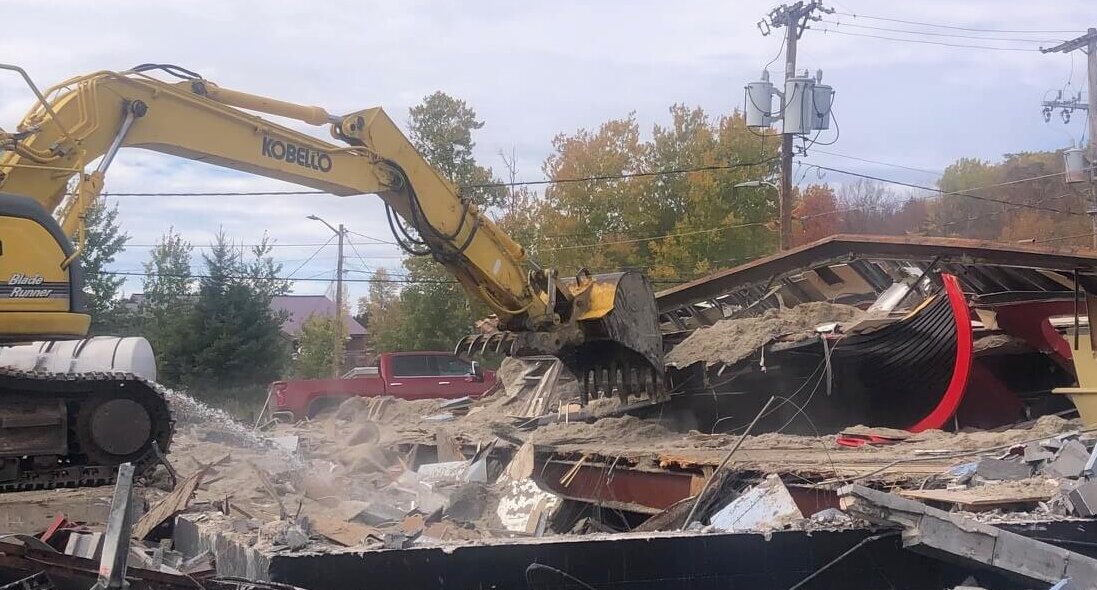
And sometimes a business just runs its course. Which brings us to the longstanding and historically popular… Villa Capri. The well-known family-run Italian restaurant closed for business earlier this year, but as long as the building stood, there was always the hope someone would come out of nowhere and reopen it.
All hope died this week with the demolition of that building. There’s nothing left of the dining area or the attached Boat Bar. The last of the bar, the bow, can be seen in the photo above.
The Villa appeared to still be a viable business when owner Mike Barbiere, after failing to find a buyer, apparently decided he’d had enough. A lifetime of late nights and unending people-pleasing would be enough to drive anyone into a well-deserved retirement.
Never Easy to Take
When a favorite restaurant closes… like the Villa Capri, or Bonanza several years ago, or the Northwoods, even longer ago, it’s a little like losing a friend.
I don’t know what the plans are for redeveloping that space, or even if there are any plans. Though that location would seem to be prime real estate for a commercial enterprise, it’s just one of many currently available around the area.
I’m pretty sure it’ll be hard to come up with something that will result in a six decade run of satisfied customers.
The Villa had its detractors. What business doesn’t? But just like we’d do with a good friend, we tend to excuse the occasional blemish. Yes, the Villa Capri ran its course. And it was a pretty good run at that.
In The Words of Bob Mahaney
In a Word on the Street post published on August 29th, I cited an investigative report in the Detroit News which questioned the manner in which a local housing project came about.
I’m not going to rehash the details of the story here. The point of my article was to question why it took an out-of-town media outlet to look into something happening here. Where was the local media?
Well, I probably don’t deserve it, but I’m going to take a little credit anyway for the Mining Journal’s recent dive into the issue. In yesterday’s publication, they published a Q&A with Veridea CEO Bob Mahaney. Veridea, along with several other vested parties, were the target of the News’ investigation, which focused on inconsistencies in the process.
Mahaney responded to the Journal’s questions with no shortage of facts and figures. He also challenged the veracity of the reporter’s findings, as well as his objectivity. You can access the full interview here.
Unless laws have been broken… which I doubt, the projects are happening, and regardless of what Bob Mahaney has to say about it, the end result will be more housing for the community. And that can’t be a bad thing.
E-bikes…
Many years ago I made the mistake of complaining about a big sign in town, which I thought had to be violating some kind of city ordinance. And in very short order I ended up on an ad hoc committee charged with looking at Marquette’s sign ordinance, in order to recommend updates.
Our small committee met regularly for a couple years going over every situation where any kind of sign could be an issue. Some of which you would never imagine an ordinance would have to address. Like an ad for a business, projected from a second floor window, on to a street below. Projected… like the Batman symbol.
Anyway, that’s what the city’s E-bike and Multi-use Task Force is going through right now. While we might think it’s just a matter of letting the bikes on the paths or not, there’s a lot more to it, starting with how do you even define an e-bike? (I suggest they’re actually motorcycles. They’re a cycle with a motor. Motorcycle.)
Meeting regularly since the middle of August, the task force has heard from a number of different stakeholders representing a wide range of interests. They’re also referring to what other communities have come up with, as well as what the state will, and will not permit.
Putting It Together
The next step is to put all that info into an AI program and let it spit out the perfect plan. Sure… if only. It’s not going to be quite that easy. The committee seems to know they’re in a no-win situation. Not only is it going to be hard to make everyone happy, it’s going to be hard to make anyone happy.
By December 11th, or sooner, they hope to have a package of recommendations ready to present to the City Commission. At that time, the commission will supposedly use that information and hopefully come up with a plan that can be put in place by next spring. Key words… supposedly and hopefully.
I say that because my sign committee experience was that the City Commission at the time, if they even looked at it, didn’t do much with our recommendations. Of course, that was their prerogative. Though I learned a lot about civic signage, I was disappointed our committee’s work went largely overlooked.
And worst of all, that damn sign I wanted taken down, still stands today.