IT’S NO GREAT STRETCH to suggest there’s a significant number of us wondering if the folks in Lansing and Washington D.C. are actually working to make life better for the folks they serve.
I do believe most elected officials approach their office fully intending to honor their campaign promises, but somewhere along the line the machinery of big government too often blocks their path. No matter how bad they’d like to initiate change, the system makes it incredibly hard, and all those good intentions get lost in the shuffle.
That’s when we, the people, need to use our power, limited as it is, to force the changes everyone, including our elected officials, want to see. The fact that there are six commas in that sentence illustrates the layers of complexity associated with societal change. The task is never easy, but it’s usually worth it.
An Organized Response
Enter a group called We the People – Michigan. The thinking behind their mission, as explained to me… “Is it possible to build enough people-power across race, class, and geography in order to change the material conditions of working-class people?”
You may be familiar with the new We the People organizer, Dana Lalonde. As a paid operative, she draws on years of experience in organized labor and currently serves on the Marquette County Board of Commissioners.
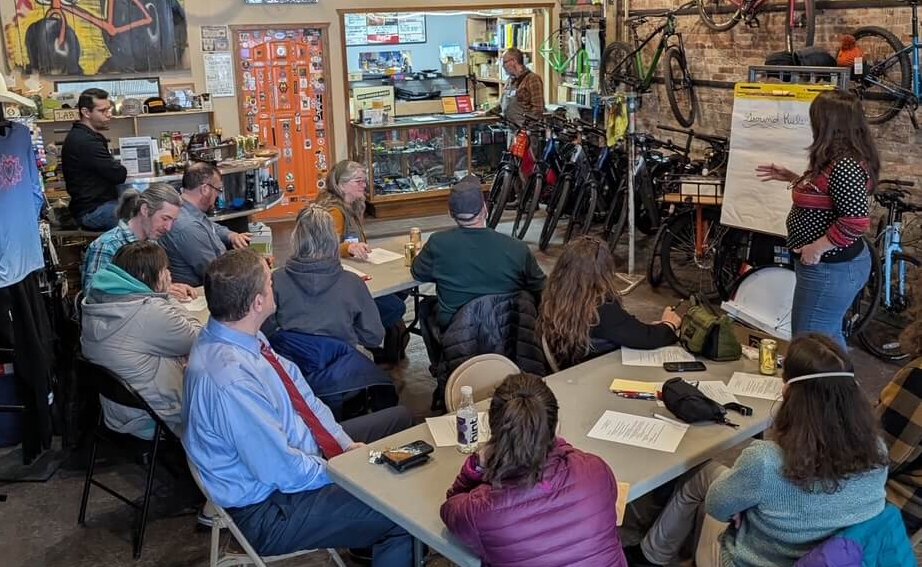
Given the freedom to address what she believes are some of the most important issues facing the central Upper Peninsula, Lalonde has begun her tenure with a focus on rural healthcare. She kicked off her crusade with a listening session, seen above, last week in Negaunee, to see if her concerns are shared with the masses. Spoiler alert… they are.
“There are clear commonalities between all of our experiences in the rural healthcare setting: insurance barriers, lack of access to providers, dental care and major gaps in mental healthcare,” Lalonde contends. “People are spending a lot of time just trying to get basic care.”
None Are Immune
Though Marquette, with our regional hospital and active medical center might not seem to be “rural,” we are. Talk to enough people about their healthcare issues and you’ll find a significant number of them having to travel great distances to find the right doctors, willing and available to address their condition.
Lalonde explains, “Access to specialists, long wait times, workforce shortages, educational assistance support for providers, and insurance barriers are all major issues. Mental health services are especially limited.” Sound familiar?
Now expand those issues out to the many remote communities where you can’t see the hospital from your house, and imagine their challenges. The recent news of the Trenary Family Medicine Clinic closing is a perfect example of the difficulties facing rural healthcare.
Industry Wide Challenges
Problems aren’t found just at the point of care. A recent article in Bridge Michigan describes what are called “ambulance deserts.” Across the state, but especially in the U.P., ambulance services are few and far between. When minutes count, miles matter.
Looking at the big picture, Lalonde believes the critical need for more efficient healthcare in rural areas cannot be overstated. “Living here in the U.P. for decades, I’ve seen how healthcare isn’t just a personal issue, it affects everything. Whether someone can keep their job. Whether families can stay in the community. Whether people delay care because it’s too far away, too expensive, or too complicated.“
Lalonde speaks from experience. “I’ve spent years navigating healthcare with my oldest son, who has complex needs including type 1 diabetes, autism and ADHD. And what I’ve learned is that in a rural community, it’s not just about having insurance, it’s about whether the care and medical supplies you need are even accessible.”
Is There an Answer?
Okay, the problem has been identified. What can we do about it? “Investing in the rural healthcare workforce, improving care coordination, expanding mental health services, and addressing insurance barriers are all key solutions. Standardized coverage for essential chronic illness, dental coverage, healthcare for all….there are many solutions.”
The listening session confirmed her belief she’s not the only one who thinks we can, and should, do better. She has another gathering scheduled for April 29th, where she hopes to further the call for action. “The next step is bringing these findings to decision makers and connecting community voices directly to the state budget and policy conversations.”
Wait… as a County Commissioner, isn’t Lalonde a decision maker? “Counties can play a role in partnerships, advocacy, and supporting local services, but many of these issues require state-level investment and policy change.”
They also require movements from grass roots organizations like We the People, abetted by the kind of community outreach sessions hosted by Lalonde. “I’ve seen people fall through the cracks, not because they didn’t try, but because the system wasn’t built for rural communities. I realized this isn’t just something we deal with individually. These are systematic issues, and if we don’t speak up about them, they don’t change.”
Lalonde sums it up, “Rural communities shouldn’t have to fight this hard just to access care. These conversations are about making sure our voices lead to real change.”